Claude Code to Elementor
I made the coded-page to Elementor conversion a script, then tested what it produces.
An independent demonstration built from Cleancut Auto Shield's public content, not affiliated with them and not a run of your pipeline on your client's site. A coded page goes in, an importable Elementor template comes out, and a real WordPress gets to say whether it arrived intact.
- ✓Imported into an empty WordPress through Elementor's own template importer, then published as a page. Styles come from the kit, not the widgets.
- ✓One colour changed in Site Settings moved all 5 calls to action on the page, and changing it back restored them.
- ✓A much longer heading, a renamed offer and a replaced photo were saved, the page reloaded, and all three were still there on the public page and at 390 pixels wide. Applied through Elementor's document save, the call its Update button makes, not by driving the editor interface.
- ✓Contents and link destinations compared section by section at three widths, replayed from scratch in CI, with a deliberately broken branch that goes red.
Validated on Elementor Free. Pro, HighLevel, tracking and forms were not tested, and a feature that would need a Pro widget is mapped in the repository rather than counted as converted. Nothing here is a promise about your installation: that takes a trial on your staging.
The coded page, and what Elementor rendered.
On the left the coded page, on the right the Elementor build, rendered by WordPress 6.8 with Elementor Free and a theme neither of us wrote. Full-page screenshots at 1440 pixels, taken by the same script that does the comparison. Both were also captured at 768 and 390.
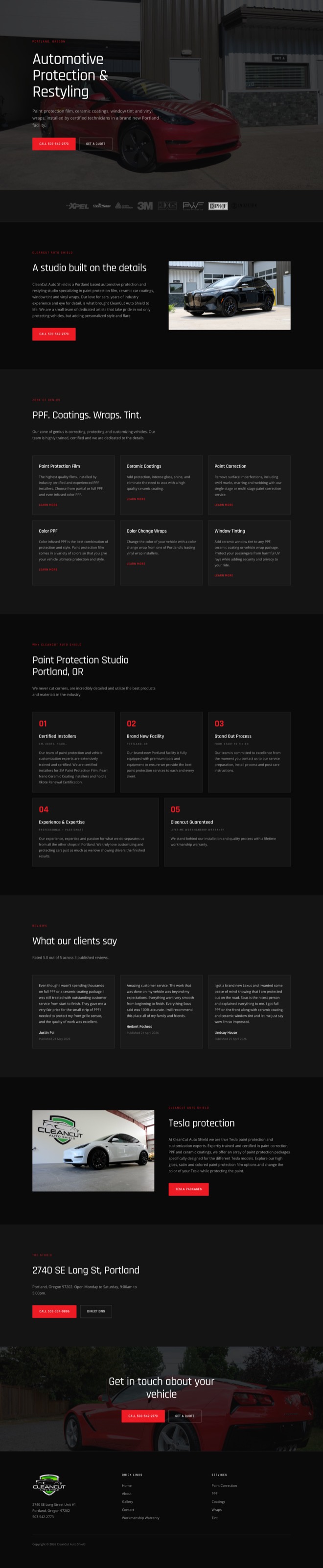
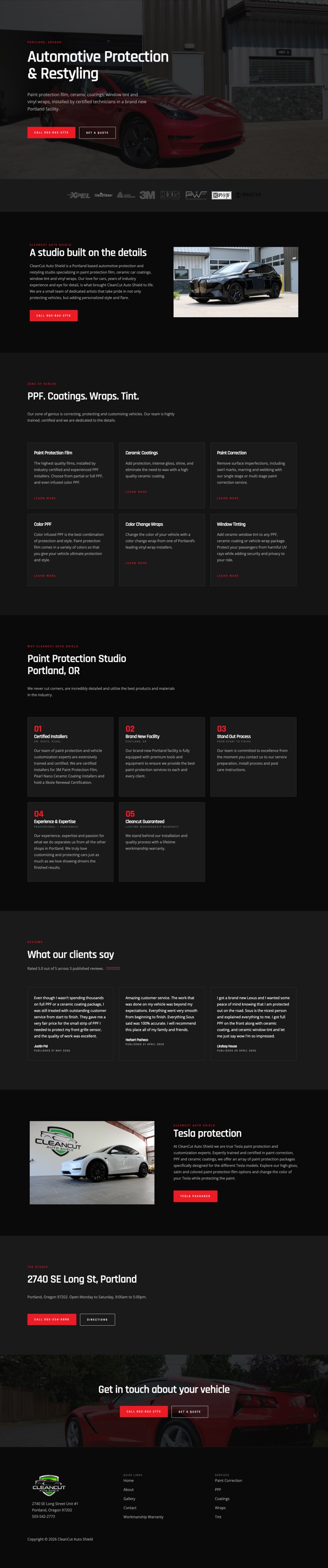
Both screenshots are at the same scale; scroll inside the frame to walk down the page. The Elementor build renders one and a half percent shorter over six thousand pixels.
›What was compared, section by section, and how
| Section | Contents and links | Pixel similarity |
|---|---|---|
| Hero | 6 of 6 as expected | 95.7% |
| Certification bar | 5 of 5 as expected | 100% |
| Studio intro | 6 of 6 as expected | 92.2% |
| Services | 5 of 5 as expected | 97.2% |
| Why block | 4 of 4 as expected | 96.8% |
| Reviews | 4 of 4 as expected | 97.3% |
| Feature block | 6 of 6 as expected | 94.3% |
| Location | 5 of 5 as expected | 98.4% |
| Closing CTA | 6 of 6 as expected | 95.7% |
| Footer | 6 of 6 as expected | 98.7% |
A check is one expected string, one expected link destination or one expected image file, looked for in the right section of the rendered page, in the right order, plus the rendered colour of each section's call to action. The expectations come from the coded page and from a written inventory of what the source page must contain, not from a second pass over the converter's own output.
Pixel similarity compares each section as a normalised thumbnail, after fonts have loaded and entrance animations have played, and is reported rather than scored: two rendering engines never agree to the pixel. The entrance animation is checked separately, by waiting for it and failing if an element never reveals.
›The edit, and every human step in the run
Tested as administrator only; the reduced role a client would be given was not tested, and the editor interface was opened on the imported page but could not be driven from a script in this environment, so the edits went through Elementor's document save instead. Every step is below.
- signed in as administrator(wp_set_auth_cookie; the client role was not tested)
- the editor interface could not be driven(the editor preview did not pick up "Automotive Protection & Restyling, and e...")
- 2 text edits applied(Elementor document save, not the editor interface)
- photo replaced with toyota-supra-ppf-portland-or-1.jpg(Elementor document save)
"No manual rebuild in Elementor" is not the same claim as "no human touched it". The steps above are the whole of what a person did.
Your team runs it, on your pages, with what you already have.
- Who runs it
- Your designers and your build person, on your machines, with your Claude account and your WordPress logins. Nothing routes through me, and there is no service to call.
- On what
- A page your team has already coded and approved, and your kit. The conversion contract is documented, its covered scope is listed, and a page outside that scope is reported with its exceptions instead of being quietly simplified to fit.
- What is left to adapt
- Your section vocabulary, your kit values, your Pro widgets, and the handover: after import, Elementor is the source of truth. There is no two way sync; regenerating a page produces a new draft, or stops if someone has edited it.
The next step that would actually tell you something: take one coded page you have already approved, and let me run it through on your staging. That answers the questions this page cannot, and it takes an afternoon.
An independent demonstration, not affiliated with Cleancut Auto Shield. The words, offers, phone numbers, reviews and photographs on the converted page are theirs, published on their own homepage, reproduced here only to show a conversion and not redistributed: the public repository ships a synthetic sample instead, no form, tracking pixel or CRM script from their site runs in the copy, no price appears anywhere because they publish none, and this page is not indexed.